
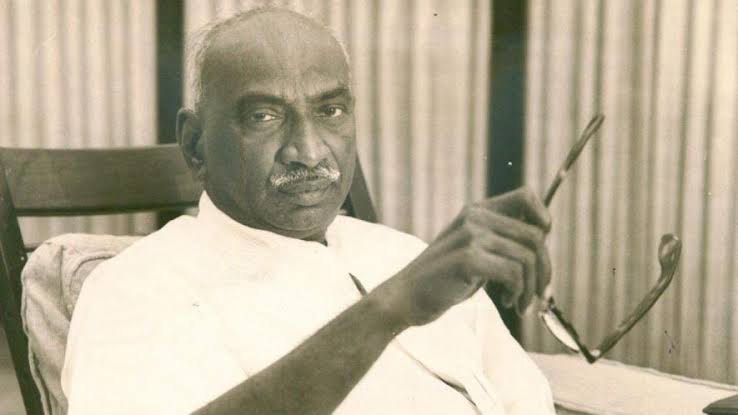
Kumaraswami Kamaraj, popularly known as Kamarajar, was an Indian independence activist, politician, and statesman who served as Chief Minister of Madras State (now Tamil Nadu) from 1954 to 1963 and later as president of the Indian National Congress.
Widely acknowledged as the “Kingmaker” of 1960s Indian politics for his role in installing two prime ministers, he is also remembered in Tamil Nadu as “Kalvi Thanthai” (“Father of Education”) for transformative education reforms, including the introduction of the mid-day meal scheme.
Profile
| Full Name | Kumaraswami Kamaraj |
| Date of Birth | July 15, 1903 |
| Date of Death | October 2, 1975 |
| Birthplace | Virudhunagar, Madras Presidency, British India (present-day Tamil Nadu) |
| State of Origin | Tamil Nadu |
| Nationality | Indian |
| Occupation | Politician, Independence Activist, Statesman |
| Parents | Kumaraswami Nadar (father, coconut merchant), Sivakami Ammal (mother) |
| Relationship Status | Remained unmarried throughout his life |
Early Life
Kumaraswami Kamaraj, originally named Kamatchi, was born on July 15, 1903, in Virudhunagar, in present-day Tamil Nadu, to Kumaraswami Nadar, a coconut merchant, and Sivakami Ammal.
He belonged to the Nadar community. His father died when Kamaraj was a young boy, and at age twelve he dropped out of school to work as a shop assistant and support his mother and sister, receiving only about six years of formal schooling in total.
Career
At fifteen, Kamaraj was profoundly affected by news of the Jallianwala Bagh massacre. He joined the Indian National Congress in 1919–1920 at around age seventeen, becoming a full-time worker in the independence movement.
He was mentored by Congress leader S. Satyamurti and participated in the Non-Cooperation Movement, the Vaikom Satyagraha (1924), the Salt Satyagraha, and other campaigns, for which he was imprisoned multiple times by British colonial authorities. He became a member of the Madras Provincial Congress Committee in 1925.
Kamaraj was elected to the Madras Presidency legislature in 1937 and again in 1946, and to the Constituent Assembly of India in 1946. In 1951, he won a seat in the first Lok Sabha.
On April 13, 1954, he was elected Chief Minister of Madras State, a position he held for three consecutive terms until October 2, 1963. As Chief Minister, he was widely credited with transforming education access in the state, introducing the mid-day meal scheme (piloted at Ettayapuram in 1956, expanded statewide during his tenure), building schools in every village, and introducing free and compulsory education.
He also expanded rural electrification, industrial development, and irrigation infrastructure, including the Amaravathi Dam and the Parambikulam-Aliyar Project.
In 1963, Kamaraj proposed what became known as the “Kamaraj Plan,” under which senior Congress leaders, including himself, would resign from government posts to focus on party organizational work; six chief ministers and six union ministers resigned as part of the plan.
He was elected president of the Indian National Congress on October 9, 1963, and following the death of Prime Minister Jawaharlal Nehru in 1964, played the decisive role in selecting Lal Bahadur Shastri as his successor. After Shastri’s death in 1966, Kamaraj was similarly instrumental in the selection of Indira Gandhi as prime minister, cementing his reputation as India’s “Kingmaker.”
Kamaraj lost his own Lok Sabha seat in Virudhunagar in 1967, a defeat that diminished his political standing, though he rebounded with a landslide win from Nagercoil in 1969. Following the 1969 split in the Congress party, he remained with the Indian National Congress (Organisation), which he founded and led. He served again in the Lok Sabha from 1969 to 1975.
Awards & Nominations
- 1976, Bharat Ratna (India’s highest civilian honour), Posthumous award
Personal Life
Kamaraj remained unmarried throughout his life, dedicating himself entirely to public service.
He followed Gandhian principles, wearing simple khadi clothing and living an austere lifestyle; he was popularly called “Black Gandhi.”
As Chief Minister, he famously ordered a direct water connection installed at his residence by the Virudhunagar municipality to be disconnected, objecting to special privileges for public officials, and he often declined police protection.
When he died on October 2, 1975, coincidentally also the twelfth anniversary of his 1963 resignation as Chief Minister, he owned no property and possessed only about ₹130, two pairs of sandals, four shirts and dhotis, and a few books.
Net Worth
Kamarajar died with negligible personal wealth, reflecting his lifelong commitment to austerity and public service over personal gain.
Works / Contributions
- Chief Minister of Madras State (1954–1963) — three consecutive terms
- Mid-day meal scheme — introduced statewide during his administration
- Kamaraj Plan (1963) — architect
- President, Indian National Congress (1964–1967)
- Founder and president, Indian National Congress (Organisation)
- Bharat Ratna (1976, posthumous)
Conclusion
From a childhood of poverty and minimal formal schooling, Kumaraswami Kamaraj rose to become one of independent India’s most consequential political figures, reshaping education in Tamil Nadu, guiding the selection of two prime ministers, and leaving behind a legacy of personal integrity that continues to be invoked in Indian public life.