
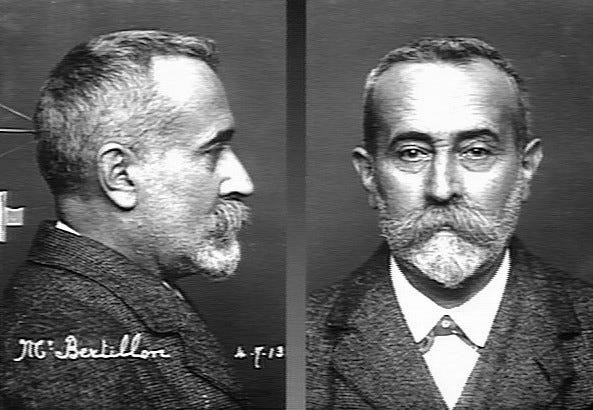
Alphonse Bertillon was a French police officer, criminologist, and biometrics researcher who fundamentally transformed the way law enforcement around the world identifies criminals.
His creation of the Bertillon System a scientific method of identifying individuals through precise physical measurements, systematic photography, and detailed records made him a global pioneer of forensic science in the late 19th century. He is also credited as the inventor of the modern “mug shot.”
Though his methods were later superseded by fingerprinting, his legacy as the father of criminal identification remains undeniable.
Profile Details
| Full Name | Alphonse Bertillon |
| Born | April 22/23, 1853 |
| Died | February 13, 1914 (aged 60) |
| Birthplace | Paris, France |
| Nationality | French |
| Occupation | Police Officer, Criminologist, Biometrics Researcher |
| Parents | Louis Adolphe Bertillon (Father – physician and statistician), Zoé Bertillon (Mother) |
| Siblings | Jacques Bertillon (brother – statistician and demographer) |
Early Life
Alphonse Bertillon was born on April 22 (some sources say April 23), 1853, in Paris, France, into a distinguished intellectual family. His father, Dr. Louis Adolphe Bertillon, was a respected physician, statistician, and vice-president of the Anthropological Society of Paris. His grandfather, Achille Guillard, was a noted naturalist and mathematician. Growing up in an environment saturated with scientific discourse, Bertillon absorbed the language of measurement, analysis, and inquiry from childhood. Names like Charles Darwin and Louis Pasteur were regularly invoked around the dinner table.
Despite his privileged intellectual upbringing, Alphonse was a problematic student. His father eventually sent him to Great Britain, where he had to rely on his own resources and fend for himself an experience that may have sharpened his independent streak and determination. Returning to France, he completed his military service before entering civilian life in 1879.
Education
Bertillon’s formal education was less distinguished than his family background might suggest. He struggled academically in his youth and did not follow a traditional scholarly path. However, his deep familiarity with his father’s work in anthropology, statistics, and physical measurement gave him a practical education that proved far more valuable than any university degree. This self-directed, applied understanding of science would become the foundation of his revolutionary work in criminal identification.
Career
In 1879, Alphonse Bertillon secured a position as a minor records clerk at the Paris Prefecture of Police the Bureau of Judicial Identification. His job was mundane: transcribing descriptions of arrested criminals onto small index cards. But the descriptions he encountered were nearly useless. Vague phrases such as “tall,” “short,” “ordinary face,” and “no distinctive features” applied to thousands of individuals and offered investigators almost no real help in identifying recidivists criminals who committed crimes repeatedly under different names.
Bertillon, drawing on his family’s scientific tradition, became determined to create a better system. He developed what became known as the Bertillon System, or Bertillonage a comprehensive method of criminal identification combining three key elements: anthropometry (precise bodily measurements of the skull, limbs, fingers, and other skeletal features), a detailed descriptive or morphological portrait of the subject’s physical characteristics, and systematic photography from both the front and side the direct predecessor of the modern mug shot.
After months of developing his system in his own time, Bertillon presented his ideas to his superiors, who were initially skeptical. After persistent lobbying, he was finally given the chance to prove his method. In 1883, the system recorded its first success when a repeat criminal was identified using Bertillon’s measurements a breakthrough that validated the entire approach and launched his reputation. That same year, the Parisian police formally adopted the Bertillon system, and Bertillon was placed in charge of the Bureau of Judicial Identification.
The Bertillon system spread rapidly across Europe and to the United States, becoming the dominant method of criminal identification for nearly two decades. Bertillon gained international celebrity, and his techniques were exhibited at major world events, including the 1893 World’s Columbian Exposition in Chicago. He also wrote extensively on his methods, most notably in La Photographie judiciaire (1890).
However, the system had a significant limitation: anthropometric measurements could not uniquely identify a person with the same precision as fingerprints. By the early 20th century, fingerprinting championed by Francis Galton and others began to supplant the Bertillon system as the preferred method of identification. By around 1910, most police agencies had transitioned fully to fingerprinting.
Bertillon’s reputation suffered a severe and perhaps irreparable blow in the infamous Dreyfus Affair. In 1894, French Army Captain Alfred Dreyfus was accused of treason. Bertillon was called upon as a handwriting expert and gave testimony that he claimed proved Dreyfus was guilty. His analysis was widely criticized as pseudoscientific and methodologically flawed. Despite overwhelming evidence in Dreyfus’s favor including the later identification of the real traitor Bertillon stubbornly refused to retract his conclusions. The Dreyfus Affair, widely described as one of the most embarrassing trials in the history of forensic science, permanently tarnished Bertillon’s legacy and exposed the limits of his scientific confidence.
Alphonse Bertillon died on February 13, 1914, in Paris, at the age of 60, having dedicated his life to the science of identification. In 2012, shortly before his death, he also wrote a paper on the uniqueness of fingerprint ridge points a final nod to the methodology that had replaced his own.
Key Contributions
- Inventor of the Bertillon System (Bertillonage) the first scientific criminal identification system
- Inventor of the standardized mug shot (front and profile photograph), introduced in 1888
- Pioneer of forensic anthropometry in law enforcement
- Author of La Photographie judiciaire (1890)
- Wrote on fingerprint ridge uniqueness in 1912
Personal Life
Alphonse Bertillon led a largely private personal life, defined by obsessive dedication to his work. His “love of order,” as historians have noted, was both his greatest professional strength and a personal trait that sometimes bordered on rigidity. The Dreyfus Affair laid bare the dangers of intellectual overconfidence a cautionary tale about a brilliant mind that could not admit when it was wrong. Bertillon never publicly retracted his testimony in the Dreyfus case, even as the rest of the world moved on. He was the younger brother of statistician and demographer Jacques Bertillon, and his niece Suzanne Bertillon later wrote about his life and legacy.
Net Worth
As a 19th-century police official and government servant, Alphonse Bertillon did not accumulate significant personal wealth. His income was derived from his public service salary as chief of criminal identification for the Paris Police Prefecture. His wealth such as it was lay entirely in intellectual achievement, international recognition, and his lasting contribution to the science of law enforcement.
FAQs
Who was Alphonse Bertillon?
Alphonse Bertillon (1853–1914) was a French police officer and criminologist who invented the first scientific system for identifying criminals, known as the Bertillon System or Bertillonage. He is also credited with inventing the mug shot.
What is the Bertillon System?
The Bertillon System is a criminal identification method based on precise anthropometric (bodily) measurements, morphological descriptions of physical features, and standardized photography. It was the primary method of criminal identification from the 1880s until fingerprinting took over in the early 1900s.
Did Alphonse Bertillon invent the mug shot?
Yes. Bertillon standardized the practice of photographing criminals from the front and side in 1888, creating the format now universally known as the mug shot.
What was Bertillon’s role in the Dreyfus Affair?
Bertillon served as a handwriting expert in the 1894 trial of Alfred Dreyfus and gave flawed testimony that contributed to Dreyfus’s wrongful conviction. He refused to retract his conclusions even after Dreyfus was exonerated, permanently damaging his reputation.
What replaced the Bertillon System?
Fingerprinting championed by Francis Galton and others replaced the Bertillon System as the primary method of criminal identification in the early 20th century, due to its greater reliability and uniqueness.
Conclusion
Alphonse Bertillon was a visionary who transformed criminal justice through the rigorous application of science. Before him, criminals could vanish simply by changing their names; after him, the human body itself became a form of identity record. Though his methods were eventually surpassed and his reputation clouded by the Dreyfus Affair, his fundamental insight that science and measurement could be the tools of justice planted the seeds of modern forensic science. Every mug shot taken today, every criminal database queried, every biometric system deployed carries the distant echo of Alphonse Bertillon’s restless, orderly mind.